
Mapping the Invisible: From Digital to Analogue.
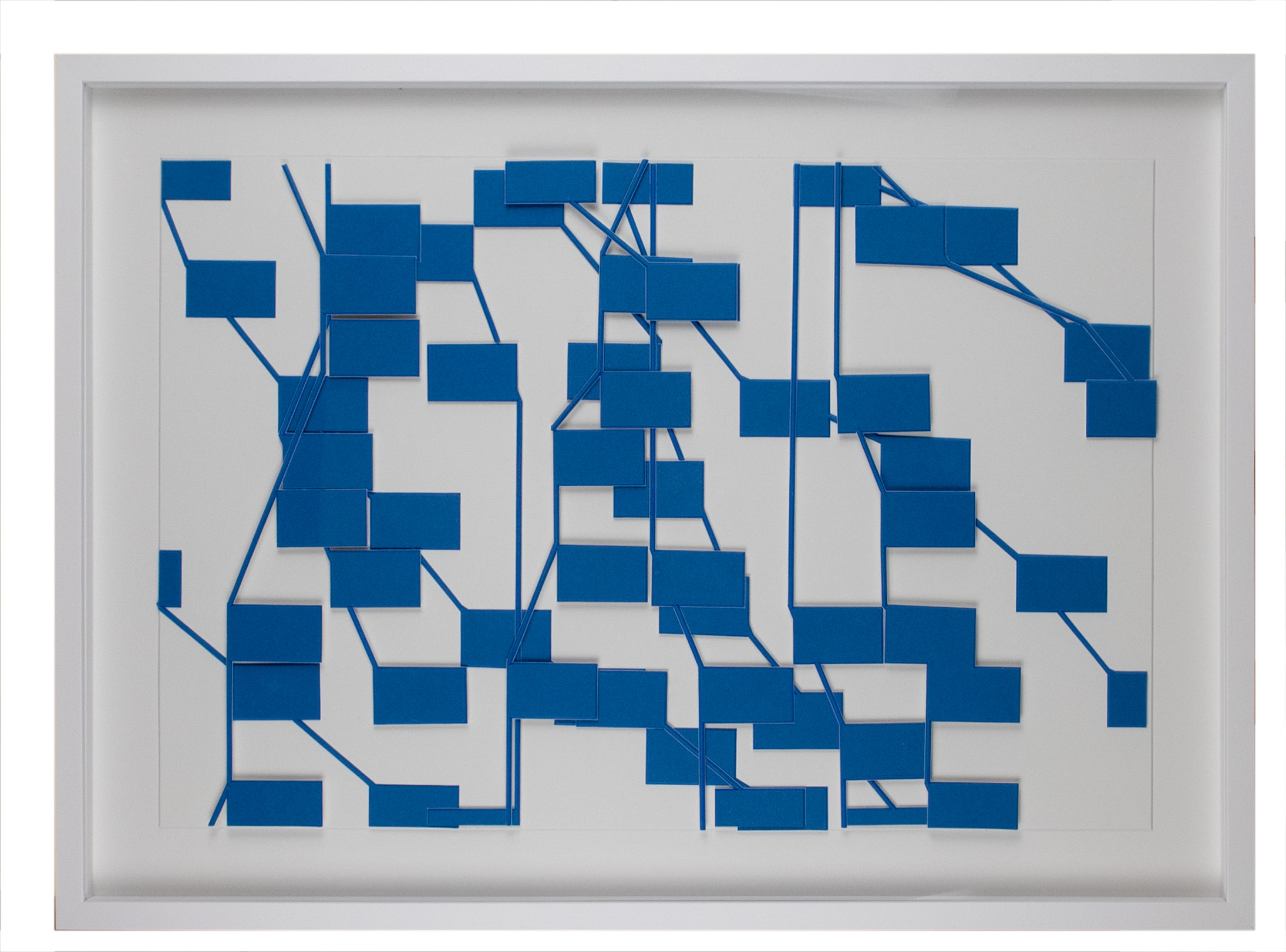
This series is, above all, a cartographic exercise. The images, generated from 2D and 3D simulations of electric fields, have been enlarged — in this case to 3200 per cent — an act that not only scales a fragment up to monumental proportions, but also seeks to unfold its internal structures within a map. But not a traditional hierarchical map, rather a territory without a centre, where bifurcations, graphic roots and pixelated matrices intertwine like nodes in an open system.
The extreme magnification reveals what Deleuze and Guattari called the rhizome: a network of non-hierarchical connections, where every point can connect to any other, with no beginning and no end. Here, the pixelation resulting from rasterisation is not an error, but the materialisation of that multiplicity: a topography of the abstract.
Blue acts as the colour of the liminal, a hue that has historically oscillated between the physical and the metaphysical. In art, blue has been the colour of the divine, but also of the technological: from the cyanotypes of the nineteenth century—one of the earliest photographic techniques, in which Prussian blue captured light without a camera—to the blue screens of operating systems, which mark the boundary between functionality and system crash. In this project, blue inherits that duality. It is no coincidence that cyan, a component of digital blue (RGB), is the same colour that, in CMYK printing, translates into a physical blue. Thus, the colour becomes a chromatic bridge between the immaterial and the tangible, an extension of reality.
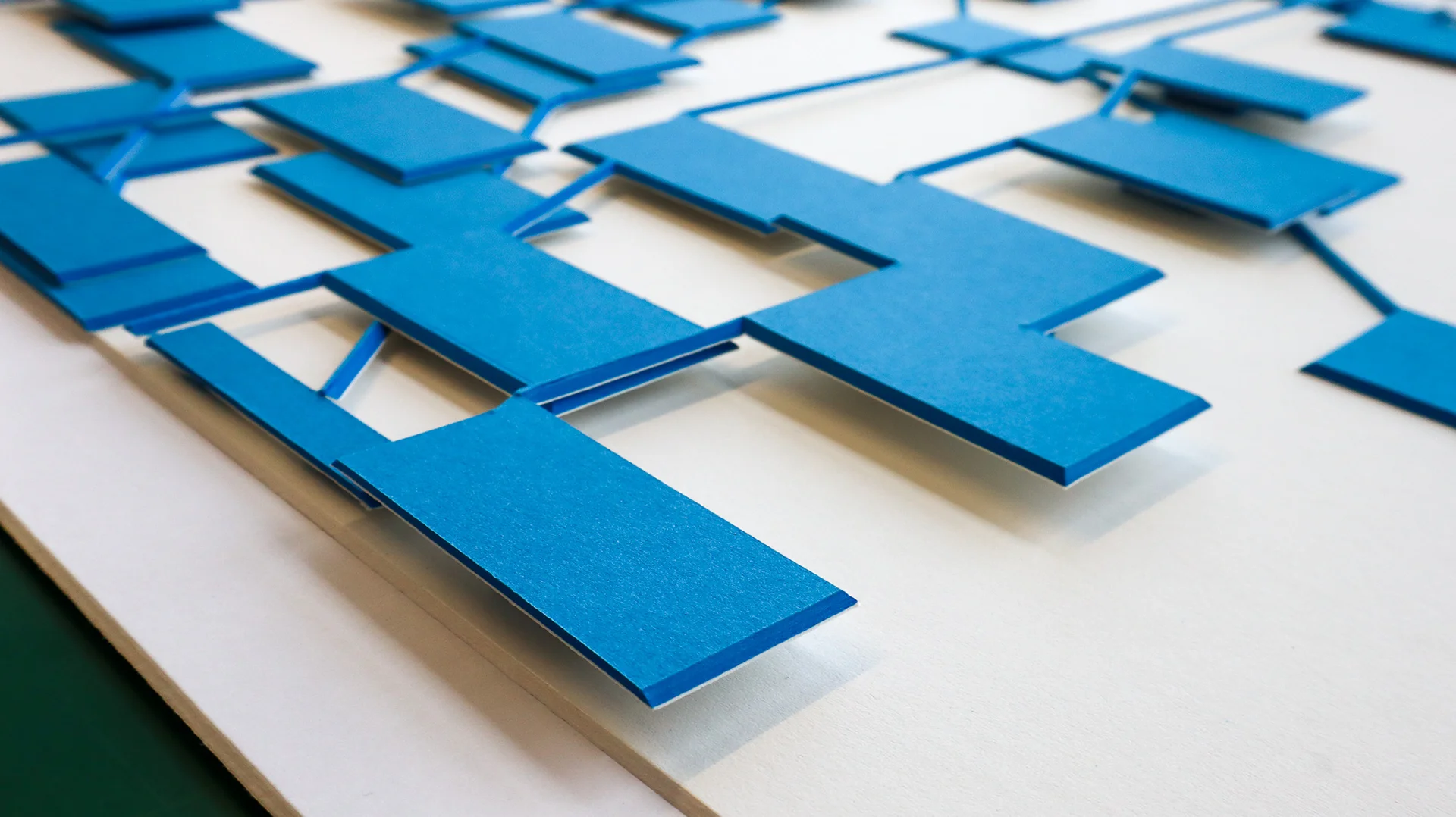
The materialisation of these images on passe-partout card adds another layer of meaning. The passe-partout, traditionally used as a frame to highlight works on paper, here becomes the very support of the work itself, cut with a machine of millimetre precision. There is a poetic irony in this process: an industrial tool, designed for exactitude, is used to create forms that tend towards the organic and imperfection. The six superimposed layers, with their sharp edges, form a relief map where the machine’s precision interacts with the warmth of the material and the imprecision of the manual assembly.
In a post-digital context, this work poses a fundamental question: how do we physically map what remains archived in digital format? The branching of the enlarged images, their rhizomatic nature and their translation into a material form suggest that contemporary art does not seek to represent reality, but rather to map it as a territory in constant transformation. The 3200 per cent enlargement, the rasterisation and the use of blue are not merely technical decisions, but strategies to reveal that the digital and the physical are not opposites, but layers of the same geography.